


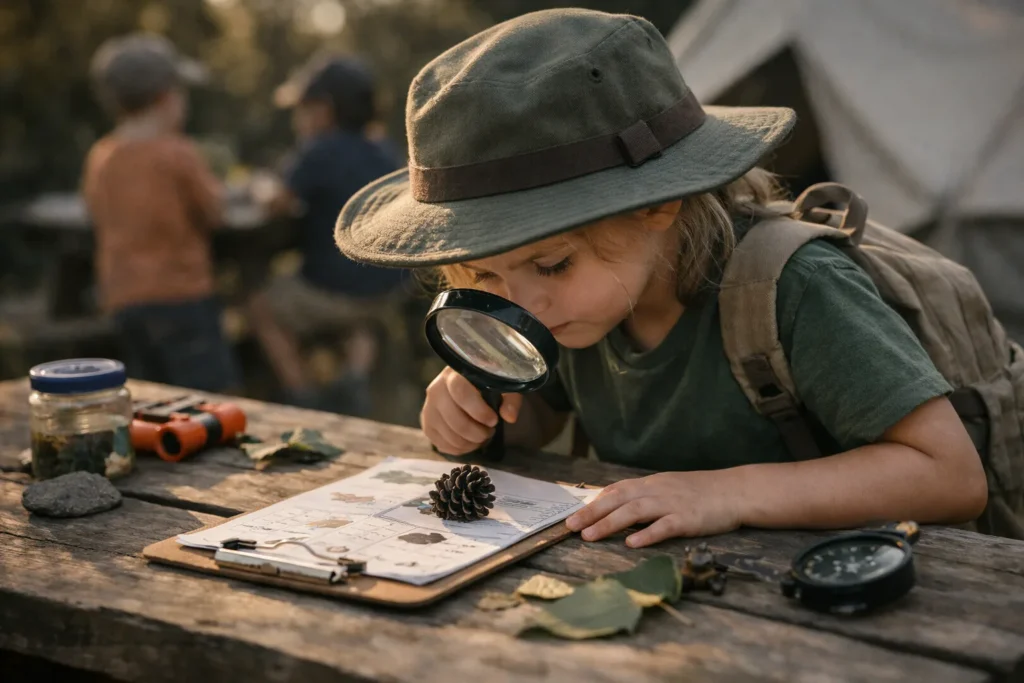
The National Park Service runs the Junior Ranger program at hundreds of parks across the country, including sites in Connecticut such as the Weir Farm National Historical Park. Children complete activities, answer questions about what they see, and earn a badge. The idea is simple and works well for a party: give kids a mission, a task, and a reward. You can read about the program at nps.gov. Below is a guide to backyard games for children ages three to ten, with the number of players and space you will need.
Games by age
| Age | Game | Players | Space needed |
|---|---|---|---|
| 3-4 | Animal walk: crawl, hop, or waddle across the yard | 4 to 10 | About 15 by 15 feet (4.5 by 4.5 m) |
| 3-4 | Bubble chase | 4 to 10 | Open lawn |
| 5-6 | Nature bingo: find a leaf, a rock, a feather | 4 to 12 | Whole yard |
| 5-6 | Red light, green light | 6 to 12 | 30 feet (9 m) of straight lawn |
| 7-8 | Relay with a bean bag or a spoon and ball | 6 to 12, in teams | 40 feet (12 m) of lawn |
| 7-8 | Ranger tracking: follow a trail of paper footprints | 4 to 10 | Whole yard |
| 9-10 | Capture the flag, small-team version | 8 to 16 | About 50 by 30 feet (15 by 9 m) |
| 9-10 | Orienteering with a simple map of the yard | 4 to 12, in pairs | Whole yard |
Make it a Junior Ranger party
Give each child a card with five tasks and a pencil. When a task is done, an adult “ranger” signs the card. At the end, each child receives a paper badge. The tasks can be a mix of games: “Find three different leaves,” “Walk like a bear across the yard,” “Name two sounds you hear in the yard,” “Complete the relay with your team.” This keeps children busy, gives shy kids a clear job, and lets you run several activities at once.
The role of the adult referee
Adults are not just there to supervise. For young children, a grown-up should explain the rules, show how to play, and stay close to the action. For older kids, an adult can be the judge, the timekeeper, and the person who settles disputes. A few things to do at every game:
- Walk the yard before the party and remove rocks, sticks, toys, and anything that could cause a trip.
- Set boundaries with cones, rope, or chalk, and keep games away from the street, a pool, or a fence that is not secure.
- Bring water, shade, and a first-aid kit. Check on children’s hydration when it is hot.
- Stop any game that gets too rough, and restart it with a clear rule.
Sun, heat, and insects
If the party is in summer, schedule active games in the morning or late afternoon, and take breaks in the shade. Use sunscreen, hats, and water breaks as the heat builds. The Centers for Disease Control and Prevention has guidance on heat illness and on preventing tick and mosquito bites. Check cdc.gov before a long outdoor party.
Keep a backup
If it rains, move the Junior Ranger cards indoors and turn the tasks into indoor games: an animal walk down a hallway, a leaf hunt with paper leaves hidden around the house, and a “quiet sounds” game. A mission works wherever you are. For more on picking a theme, take a look at the Party themes and decor section.