


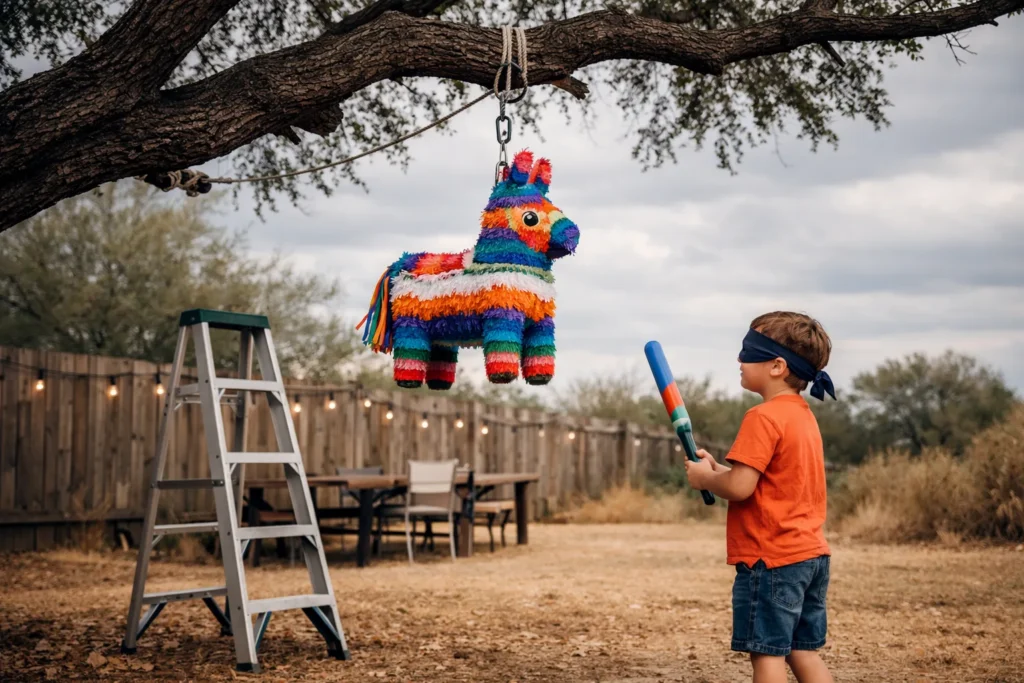
In San Antonio, a piñata is not a novelty. It is part of the birthday tradition, and families there tend to know a few tricks that keep the swinging fun and the injuries away. These steps work in any backyard, whether you are in Texas or anywhere else in the country.
Choose the right spot
Look for a sturdy horizontal tree limb at least 8 feet (2.4 m) off the ground, or build a hanging point from a freestanding frame. Avoid porch beams that are rotten, a power line, or a swing set that wobbles. The limb must be strong enough to hold the piñata plus the pulling and tugging it will get, which is more than the weight of the piñata itself.
Check the ground below. You want flat, open grass with no sprinkler heads, tree roots, or lawn furniture in the swing zone. A hard patio is a poor choice because kids who step back and trip will land on it.
Pick the rope
Use a smooth, strong rope or cord rather than thin string. Thin string can snap, drop the piñata early, and cut a hand when someone pulls it. A length of cotton or nylon rope about a quarter inch (6 mm) thick is plenty. Tie the rope to the limb with a knot you trust and test it by hanging your full weight from the rope for a moment before the piñata goes up.
Many families use a second rope held by an adult standing back, so the piñata can be raised and lowered between turns. It makes the game fairer for the smallest kids, who can get a lower target, and it keeps the piñata from being smashed by the first swing.
Set the turn order and the safety circle
Line up the kids from youngest to oldest, and give each child a set number of swings, usually three to five. The youngest should go first because the piñata is full and hard to break. Older kids, who swing harder, can go last, when it is already cracked.
Mark a circle on the grass with a garden hose or a rope laid on the ground. The batter stands in the middle, and everyone else stays outside the line. A good rule is a distance of at least twice the length of the bat, plus a little extra. Adults should keep the line.
The bat and the blindfold
Use a light plastic bat or a cardboard tube rather than a heavy wooden one. A blindfold adds fun for older kids, but skip it for preschoolers. Little kids who cannot see tend to spin, drift, and swing toward the crowd. If you want the tradition, let older kids use a loose blindfold under the supervision of an adult who stands beside them and turns them gently by the shoulders.
Insist on one rule: when the batter finishes a turn, the bat goes on the ground, handle toward the adult. Nobody swings while another child is retrieving candy.
When the piñata breaks
The moment of the break is the most chaotic part of the game. A good trick is to fill the piñata with wrapped items and place a few in a bag as a backup, then have everyone sit down while an adult hands out the treats evenly. A rush for the candy on the ground can lead to bumped heads and scraped hands.
Fill the piñata with items that suit the youngest guests. The U.S. Consumer Product Safety Commission warns that small objects are a choking risk for children under 3, and hard candy is a risk for young kids as well. Choose soft, wrapped treats, stickers, and small toys that are rated for the youngest age in the group, and tell parents about any nuts in the mix.
A short checklist
- Test the rope and the limb before the party.
- Clear the area and mark the circle.
- Line up the kids by age and set the number of swings.
- Use a light bat and skip the blindfold for the little ones.
- Keep an adult near the piñata at all times.
- Collect the bat and the broken pieces when the game ends.
For more ways to build a lively, safe afternoon, browse the ideas in our venues and budget section if the backyard will not fit the crowd. Photos and history of the tradition can be found on Wikipedia, which is a good starting point if you want to tell the kids where the piñata came from.