

December is full of celebrations, and many families mark more than one. A class party, a neighborhood gathering, or a playdate can be a chance to learn about each tradition without making any of them seem like an afterthought. The key is to invite families to share how they celebrate, to keep the activities simple, and to let each holiday stand on its own.
The holidays at a glance
| Holiday | Typical dates | Activity | Treat |
|---|---|---|---|
| Hanukkah | Eight nights, starting between late November and late December (it follows the Hebrew calendar) | Spinning the dreidel, a gelt game, a paper menorah craft | Potato latkes with applesauce, or chocolate coins |
| Christmas | December 25 | Ornament decorating, a gingerbread house, caroling | Sugar cookies or hot chocolate |
| Kwanzaa | December 26 to January 1 | Learning the seven principles, making a paper kinara, drumming | Fruit, sweet potato dishes, or cornbread |
Dates change from year to year for Hanukkah, so check a calendar before you set a party date. Kwanzaa and Christmas stay fixed.
Plan with respect
Before you plan, ask the parents of the children you invite which holidays they celebrate and whether they prefer a party without a religious theme. Present each tradition as one that people celebrate, not as a game. Let families who observe a holiday tell the story or lead an activity if they would like to, and avoid asking a child to explain a tradition on the spot.
A school party often follows district policy on religious content, so read the policy and ask the teacher. Neutral themes, such as snowflakes, hot cocoa, and winter crafts, are a safe base that includes every child.
Activities for Hanukkah
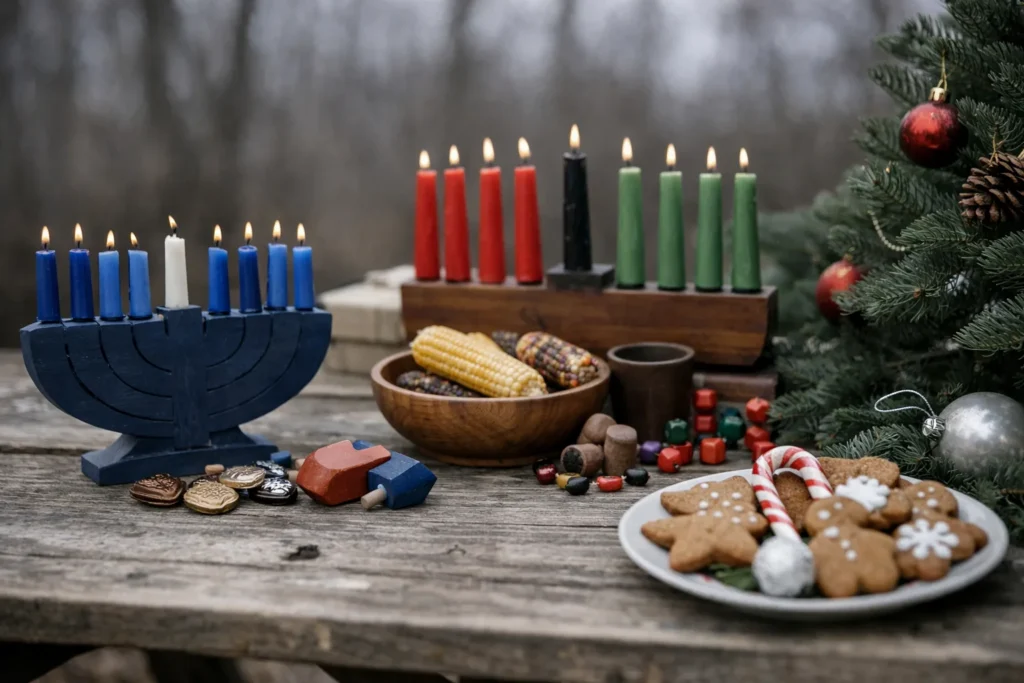
Hanukkah is an eight-night festival of lights. Kids enjoy a dreidel game with chocolate coins or pretzels as the “pot,” a paper menorah with a candle cut from paper, and blue and white decorations. Use paper or battery candles instead of real flames at a children’s party. A short explanation of the miracle of the oil in the temple, told by a family who celebrates it, adds meaning to the game. A short overview of the holiday is available on Wikipedia.
Activities for Kwanzaa
Kwanzaa, a seven-day celebration of African American culture and heritage, begins on December 26. Each day highlights one of seven principles, such as unity and creativity. Kids can make a paper kinara with seven candles in red, black, and green, try a simple drum circle, or hear a story about one of the principles. Because Kwanzaa comes after Christmas, a party in the days after the holiday can be a quiet, meaningful gathering.
Activities for Christmas
For a Christmas party, popular choices include decorating paper ornaments, assembling a small gingerbread house from a graham cracker kit, and a simple caroling walk around the block. Offer a cookie-decorating table and keep a few allergen-free options on hand for children with food allergies.
Treats and allergies
Many winter treats include nuts, eggs, and dairy. Ask parents about allergies before you bake, and label every dish. Offer fruit, popcorn for older kids, and a drink such as warm apple cider. Keep small candies out of reach of children under 4.
Keep it short and calm
December is busy. An hour and a half is plenty for a party with young children, with one activity per tradition and a break in the middle for a snack. Send a thank-you note afterward that mentions what each family shared. For help with the budget of a larger event, see our venues and budget section.